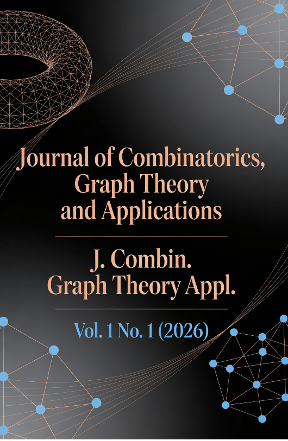
Journal of Combinatorics,
Graph Theory and Applications
ISSN : 3117-7980
Editor in Chief: Dr. LiMin Yang, Email: yanglm65@aliyun.com
Click here for Complete List of Editorial Board
Aim and Scope
Journal of Combinatorics, Graph Theory and Applications
Journal of Combinatorics, Graph Theory and Applications (JCGTA) is a multidisciplinary peer-reviewed Combinatorics and Graph theory journal publishing articles in the field of Combinatorics and Graph theory. Journal of Combinatorics, Graph Theory and Applications is presented to the publication of a substantial advance in their field or a significant contribution, articles on all aspects of combinatorics, graph theory and application.
The journal features articles on combinatorics, graph theory discrete mathematics, mathematical biology, and theoretical computer science.
The scope of the journal includes research main areas:
1 Graph Theory gained by combinatorial theory
2 Combinatorics from graph theory
3 Applications on graph theory (codes from graph theory)
4 Applications on combinatorics (combinatorial biology )
Scope – Core Areas
The journal welcomes papers in all mainstream areas of modern combinatorics, that fit within its interdisciplinary profile. Typical topics include, but are not limited to:
Graph theory (classical, extremal, algebraic, structural, and random graphs) and hypergraph theory.
Extremal and probabilistic combinatorics, including Ramsey theory, random structures, and probabilistic methods in discrete mathematics.
Discrete probability, combinatorial probability, and limit theorems for random combinatorial structures and stochastic processes on graphs.
Theoretical computer science topics with strong combinatorial or probabilistic content, such as algorithms, complexity theory, randomized algorithms, and probabilistic analysis of algorithms.
Scope – Methods and Applications
Beyond subject labels, the journal focuses on work that uses sophisticated discrete, probabilistic, and computational techniques in a mutually reinforcing way. Submissions may emphasize:
New combinatorial or probabilistic methods with potential for broad use in discrete mathematics, computer science, or statistics.
Algorithmic and optimization aspects of combinatorial structures, including approximation algorithms, random walks, Markov chain Monte Carlo, and learning‑theoretic approaches.
Applications of combinatorics and probability to areas such as communication networks, coding and information theory, statistical physics models on graphs, random matrices, or complex networks, when they feature substantial theoretical innovation.
Article Types and Audience
Article Types
The journal focuses on original research papers presenting novel results in combinatorics, graph theory, and their applications. Survey papers and expository articles synthesize key developments, while short communications report breakthroughs suitable for rapid dissemination.
Intended Audience
Researchers, postgraduate students, and advanced practitioners in combinatorics, graph theory, discrete mathematics, and related fields such as theoretical computer science and mathematical biology form the core readership. Content emphasizes rigorous proofs, algorithmic insights, and practical applications accessible to specialists across these areas.
Exclusions and Fit
Journal of Combinatorics, Graph Theory and Applications excludes submissions outside its core scope, such as purely continuous mathematics, dynamical systems, or differential equations. Manuscripts focused solely on experimental results, applied problems without theoretical novelty, or unrelated fields like linear algebra and abstract algebra do not fit.
Papers on continuous analysis, differential equations, or dynamical systems, as the journal emphasizes discrete structures.
Primarily computational or experimental work lacking rigorous proofs or combinatorial insights.
Topics in fuzzy sets, cryptography without graph/combinatorial emphasis, or unrelated algebraic structure
Submission: Authors are requested to submit their papers electronically to editorial.jcgta@gmail.com: yanglm65@aliyun.com
Indexing and Abstracting: JCGTA will be Google Scholar, Zenodo, OpenAIRE, Digital Object Identifier, Index Copernicus, Academia
Article Processing Charges: The journal publish articles in Open Access Model. In this Open Access model, the publication cost should be covered by the author's institution or research funds. These Open Access charges replace subscription charges and allow the publishers to give the published material away for free to all interested online visitors. The charges for page charges in the journal is $ 50.
ISSN: Journal of Combinatorics, Graph Theory and Applications : 3117-7980
Start Year: 2026
Subject Area: Combinatorics, Graph Theory and Applications
License(s) permitted by the journal: All articles are published under a Creative Commons Attribution License (CC BY 4.0). This license enables users to share, adapt, and build upon the material for any purpose, even commercially, as long as proper attribution is given to the author(s). More information about the CC BY license can be found at the Creative Commons website.
Language of the journal : English
Open Access Statement: Journal of Combinatorics, Graph Theory and Applications is an open access journal Click here to Read More...
Frequency: Two issues per year are published i.e. June and December every year.
Publication Format: Online
Website: www.jcgta.com
Plagiarism: All the articles will be check through Turnitin Software before the publication of the journal.
Abbreviation: J. Combin. Graph Theory Appl.
Review Process: This journal uses double-blind review, which means that both the reviewer and author identities are concealed from the reviewers, and vice versa, throughout the review process. The articles is submitted to minimum 3 reviewers specialize on the topic for their reviews. Click Here to Read More
Corrections to Published Work:
Honest errors are a part of research and publishing and require publication of a correction when they are detected. We expect authors to inform the Journal’s Editor of any errors of fact they have noticed or been informed of in their article once published. Corrections are made at the journal’s discretion. The correction procedure depends on the publication stage of the article, but in all circumstances a correction notice is published as soon as possible. Details can be found on the Call for Papers section of the journal website.
Retractions: Retractions are considered by journal editors in cases of evidence of unreliable data or findings, plagiarism, duplicate publication, and unethical research. We may consider an expression of concern notice if an article is under investigation. All retraction notices will explain why the article was retracted. The retraction procedure depends on the publication stage of the article.
"Journal of Combinatorics, Graph Theory and Applications"
© Copyright Journal of Combinatorics, Graph Theory and Applications